
X90 vs X99: ITA Tools Compression Bits Compared Head to Head
X90 vs X99 compression bits side by side: geometry, carbide grade, Platinium coating and tool life - which one earns its price.
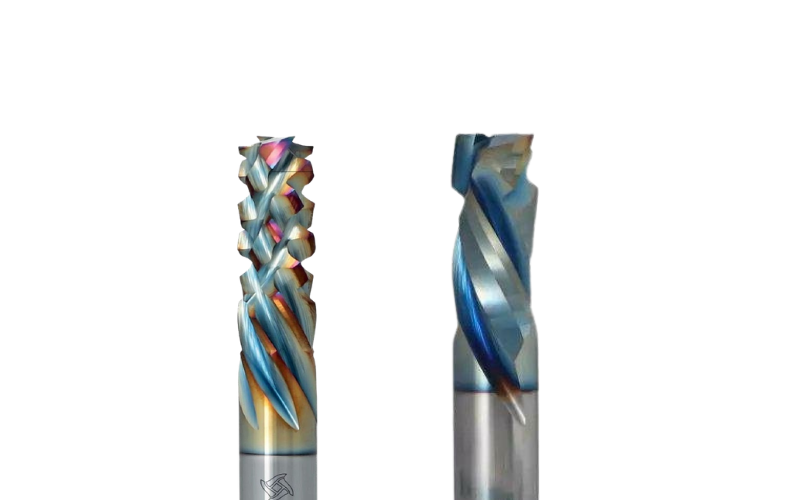
ITA Tools makes two compression router bits that look similar on paper but perform very differently on the shopfloor. The X90 has been a reliable workhorse for years. The X99 arrived more recently with a redesigned geometry, harder carbide, and a dual-layer coating — at roughly 30% more cost. The question every CNC operator asks is straightforward: is the X99 worth the extra money, or is the X90 good enough?
This article answers that with hard data — geometry, carbide grade, coating, tool life, and real-world test results from UK and European workshops. We also map out where each bit makes financial sense, and where diamond tooling (DTE, DTF) remains the better investment.
X90: what you get for the money
The X90 compression bit uses a standard Z2+2 geometry — two upcut cutting edges on the lower section, two downcut edges on the upper section. The upcut portion pulls chips away from the bottom surface while the downcut portion pushes the top laminate down, producing clean edges on both faces of double-sided panels. If you need a refresher on how this mechanism works, see our compression router bit guide.
What separates the X90 from generic compression bits is the carbide grade. ITA Tools uses an enhanced tungsten carbide formulation rather than the baseline grades found in budget tooling, delivering noticeably better edge retention in laminated chipboard compared to unbranded imports.
The X90 has no coating. It relies entirely on the carbide substrate for wear resistance. Available from 8 mm diameter upward, with 12 mm and 16 mm being most popular for CNC nesting. Price sits around £85 for a 12 mm bit — competitive with any European-brand compression bit and significantly cheaper than Leitz or Freud equivalents.
Where the X90 performs well: General-purpose nesting in raw chipboard, softwood plywood, and light MDF work at moderate feed rates (10-15 m/min). For workshops cutting fewer than 50 sheets per month, the X90 is a sensible, cost-effective choice.
X99: what changed and why it matters
The X99 is not an incremental update to the X90. It is a fundamentally different tool across three key dimensions: geometry, carbide composition, and surface treatment.
Geometry: Z2+6 "hedgehog" design
The X99 replaces the X90's Z2+2 layout with a Z2+6 configuration — two main cutting edges plus six chip-breaking elements. These additional elements fragment chips into smaller pieces as they form, reducing the mechanical and thermal load on the primary cutting edges. Smaller chips evacuate faster and pack less tightly in the flute channels. The practical result: the X99 runs measurably cooler than the X90 at the same feed rate, and lower cutting temperature directly translates to longer tool life.
Carbide: harder grade, less cobalt
Tungsten carbide is a composite — carbide particles bonded by cobalt. More cobalt means tougher but softer; less cobalt means harder and more wear-resistant, but more brittle. The X99 uses a reduced-cobalt grade, shifting the balance toward hardness and abrasion resistance — exactly what matters in laminated chipboard and MDF, where the primary failure mode is gradual edge rounding rather than sudden chipping.
Coating: Platinium dual-layer system
The X90 has no coating. The X99 has a proprietary Platinium coating consisting of two functional layers. The first is a tribological layer that reduces friction between the cutting edge and workpiece — less friction means less heat, less material adhesion, and smoother chip flow. The second is a hardening layer that provides a sacrificial barrier above the base carbide, delaying exposure of the substrate underneath.
Harder carbide plus dual-purpose coating creates a tool that resists wear through two independent mechanisms simultaneously. This is why the X99's performance jump over the X90 is not marginal — it is generational.
X90 vs X99: the full comparison
| Specification | X90 | X99 |
|---|---|---|
| Geometry | Z2+2 (2 upcut, 2 downcut) | Z2+6 (2 cutting + 6 chip-breakers) |
| Carbide grade | Enhanced standard | Harder grade, reduced cobalt |
| Coating | None | Platinium dual-layer (tribological + hardening) |
| Diameters available | 8 mm and above | 8 mm and above |
| Most popular sizes | 12 mm, 16 mm | 12 mm, 16 mm |
| Recommended feed rate | 10-15 m/min | 15-20 m/min |
| Optimal RPM (12 mm) | 18,000-20,000 | 18,000-22,000 |
| Tool life vs standard carbide | 1.5-2x | 3-10x |
| Estimated linear metres (18 mm chipboard) | 200-500 m | 600-2,000 m |
| Resharpening | Generally not economic | Generally not economic |
| Heat generation | Moderate | Low (coating + chip-breakers) |
| Edge quality at end of life | Gradual decline | Holds quality longer, then declines rapidly |
| Best material | Raw chipboard, softwood plywood | Laminated chipboard, MDF, hardwood plywood |
| Price (12 mm) | ~£85 | ~£63 |
| Cost per linear metre (chipboard) | £0.15-0.30 | £0.04-0.12 |
The price difference between X90 and X99 is roughly £20 per bit. The performance difference — particularly in abrasive laminated materials — is anything but marginal.
Real-world test results: what the workshops report
The X99's field performance has been exceptional enough to surprise even ITA Tools' own engineering team. An ITA applications technician summarised the feedback bluntly: "I have had absurdly good feedback on the X99. So good that I am starting to wonder whether our own diamond nesting bits make sense for some of these customers."
The four-shift test
One of the most telling data points comes from a production facility running laminated chipboard nesting on a flat-bed CNC. The operator loaded an X99 12 mm compression bit and ran it through four consecutive shifts without a tool change — approximately 3,200 linear metres at 20,000 RPM and 20 m/min feed rate.
The bit — costing approximately £63 — held a production-grade edge throughout. Edge quality on both laminate faces remained within specification for the entire run. In the same application, a standard carbide compression bit would typically require replacement after a single shift, sometimes less.
The technician's reaction: "A bit costing 80 euros, four shifts. That is abnormal. That is not what carbide is supposed to do."
Wood and Panel Europe recognition
The X99 was featured in Wood and Panel Europe magazine (January 2025 edition), described as a potential game changer for the CNC routing sector. The publication highlighted the combination of the Z2+6 geometry and Platinium coating as a significant advancement in carbide compression tooling.
Consistency across workshops
What makes these results credible is consistency across multiple workshops running different machines at different parameters. The X99 repeatedly delivers 3-10 times the linear metres of standard carbide. The lower end (3x) applies to extremely abrasive HPL-faced boards; the upper end (10x) to raw chipboard where the coating's friction reduction has maximum effect.
When the X90 is enough
Despite the X99's impressive results, the X90 remains a legitimate choice in several scenarios:
Low volume production (under 50 sheets per month). At two or three sheets per day, even the X90's shorter tool life gives you several days between changes. The £20 saving per bit adds up on a tight budget.
Softer, non-abrasive materials. Raw chipboard without laminate, softwood plywood, and pine solid wood do not test cutting edges the way melamine does. The X99's coating advantage is less pronounced when abrasive wear is not the primary failure mode.
One-off or prototype work. If you are cutting a dozen parts for a sample kitchen or trade show display, tool life economics are irrelevant. The X90 cuts cleanly, costs less, and does the job.
Budget-constrained startups. A new workshop buying its first tooling set may prioritise saving £20 per bit across multiple diameters. As the technician puts it: "The X90 is still a good bit. Not every workshop needs the X99."
When the X99 is worth the extra money
The X99 becomes the clear choice when any of the following conditions apply:
Laminated chipboard is your primary material. Melamine and HPL laminates are the most abrasive panel materials in common use. The X99 was designed specifically for this workload. If Egger or Kronospan melamine-faced board is what your CNC eats every day, the X99 pays for itself within the first 200 metres of additional tool life.
You are cutting 50-200 sheets per month. This is the volume sweet spot for the X99. Diamond tooling becomes economic above 200 sheets, and below 50 sheets the X90 is adequate. In between, the X99 delivers the best cost-per-metre of any carbide option available. For more on volume thresholds, see our guide on diamond vs carbide: when to switch.
MDF is a significant part of your mix. MDF's fine abrasive dust destroys uncoated carbide at an alarming rate. The X99's Platinium coating acts as a barrier against this dust, extending tool life substantially compared to any uncoated alternative. For dedicated MDF production at higher volumes, PCD diamond (DTF series) remains the gold standard — but the X99 bridges the gap for mixed-material workshops.
You run at 15-20 m/min. This feed rate range pushes the X90 toward its limits in abrasive materials, but sits comfortably within the X99's design envelope. If your Biesse, SCM, or Homag CNC runs at production speeds in this bracket, the X99 maintains edge quality where the X90 starts to show accelerated wear.
You want a disposable tool with no resharpening hassle. The X99 costs little enough to be genuinely disposable — run it until it is done, bin it, load a fresh one. No resharpening logistics, no turnaround time, no quality variation between sharpenings.
As a backup to diamond. Many production workshops keep X99 bits as their secondary tool. Diamond runs the main production; the X99 covers short runs, special orders, or emergency cover when the PCD bit is away for resharpening. At ~£63, the insurance cost is minimal.
X99 vs diamond (DTE): where each one wins
The X99's performance is remarkable for a carbide tool, but it does not replace PCD diamond for every application. Here is how they compare directly:
| Factor | X99 (Carbide) | DTE (PCD Diamond) |
|---|---|---|
| Price (12 mm) | ~£63 | ~£200 |
| Tool life (laminated chipboard) | 600-2,000 m | 3,000-8,000 m |
| Resharpening | Not economic (disposable) | 3-4 resharpenings (extends total life to 12,000-30,000 m) |
| Maximum feed rate | 20 m/min | 25+ m/min |
| Cost per linear metre | £0.04-0.12 | £0.008-0.03 |
| Upfront investment | Low (~£63) | High (~£200) |
| Downtime for resharpening | None (replace and go) | 1-2 weeks turnaround per service |
| Best volume range | 50-200 sheets/month | 200+ sheets/month |
| Edge quality consistency | Very good, degrades at end of life | Excellent, consistent until sudden decline |
| MDF performance | Good (coating helps significantly) | Excellent (30x standard carbide life) |
The crossover point: Above 20 m/min and 200+ sheets per month, the DTE diamond bit delivers a lower cost per metre despite the higher price. At 15-18 m/min and 50-150 sheets, the X99 offers equal or better economics because you avoid the resharpening cycle entirely. For workshops in the 150-250 sheet range, either tool can work depending on machine speed and material mix. Our tool life guide covers the full economics.
Our verdict: the X99 is the new default carbide recommendation
The X99 occupies a position that did not exist before it arrived. It is too good to be called "just carbide" and too affordable to compete directly with diamond. It sits in between — what the ITA technician describes as the golden middle ground between tungsten carbide and PCD.
For the majority of UK furniture workshops running CNC nesting at moderate speeds and volumes, the X99 is now the compression bit we recommend first. The £20 premium over the X90 buys you 3-5 times the tool life in laminated chipboard, measurably lower cutting temperatures, and the confidence to push feed rates into the 15-20 m/min range without worrying about premature wear.
The X90 remains perfectly functional for low-volume work and softer materials. But for anyone cutting laminated panels at production speeds, the X99's cost-per-metre advantage makes the X90 hard to justify.
For high-volume operations above 200 sheets per month, DTE and DTF diamond tooling takes over. The X99 does not replace diamond at the top end — but it has dramatically raised the ceiling of what carbide compression bits can deliver. For the complete picture on compression mechanics and material selection, start with our compression router bit explainer.
Frequently Asked Questions
Is the X99 just an X90 with a coating?
No. The X99 differs from the X90 in three ways: a redesigned Z2+6 geometry (versus Z2+2), a harder carbide grade with less cobalt, and the Platinium dual-layer coating. The coating is the most visible difference, but the geometry and carbide changes contribute equally to the performance improvement. Removing the coating from an X99 would still leave a better-performing tool than the X90.
Can I run the X99 at the same parameters as the X90?
Yes — and you will get significantly longer tool life. The X99 handles up to 20 m/min versus the X90's comfortable 15 m/min, but running it at X90 parameters simply extends its lifespan further. Many operators run X99 at 18,000 RPM and 15 m/min and report four to six times the X90's tool life. For parameter calculations, see our feeds and speeds guide.
Does the X99 work well in MDF?
Better than any other carbide compression bit we have tested. The Platinium coating is particularly effective against MDF's fine abrasive dust. For dedicated MDF production at higher volumes, PCD diamond (DTF series) still delivers dramatically longer tool life — but the X99 is the best carbide option for mixed-material workshops.
How many sheets can I expect from one X99 bit?
In 18 mm laminated chipboard at 18,000-20,000 RPM and 15-18 m/min, operators consistently report 40-120 full sheets (2,800 x 2,070 mm) per bit depending on nesting density and cut complexity. The four-shift test mentioned above equates to roughly 80-100 sheets. In raw chipboard without laminate, expect the upper end of that range or higher. In MDF, expect 30-60% of the chipboard figures.
Should I switch from X90 to X99 if I am happy with my current results?
If you are cutting fewer than 30 sheets per month in non-laminated materials and your X90 costs are manageable, there is no urgent reason to switch. But if you track your tooling costs per metre — and every production shop should — running even one X99 as a trial alongside your X90 stock will give you a direct comparison. Most operators who trial the X99 do not go back.
Can either the X90 or X99 replace diamond tooling entirely?
Not for high-speed, high-volume production. Above 200 sheets per month at 20+ m/min, PCD diamond (DTE or DTF) delivers a lower cost per metre. The X99 excels in the 50-200 sheet range — the golden middle where diamond's upfront cost is hard to justify but standard carbide wears out too quickly. Read our CNC nesting guide for the complete decision framework.
Ready to test the X99 in your workshop? At around £63 for a 12 mm bit, the X99 is the most cost-effective compression bit upgrade for CNC nesting. Browse the full X99 range and X90 range at smarterproduction.co.uk, or explore our complete compression router bit collection. Not sure which suits your volume? Contact us — we will calculate the cost-per-metre for your production scenario.


