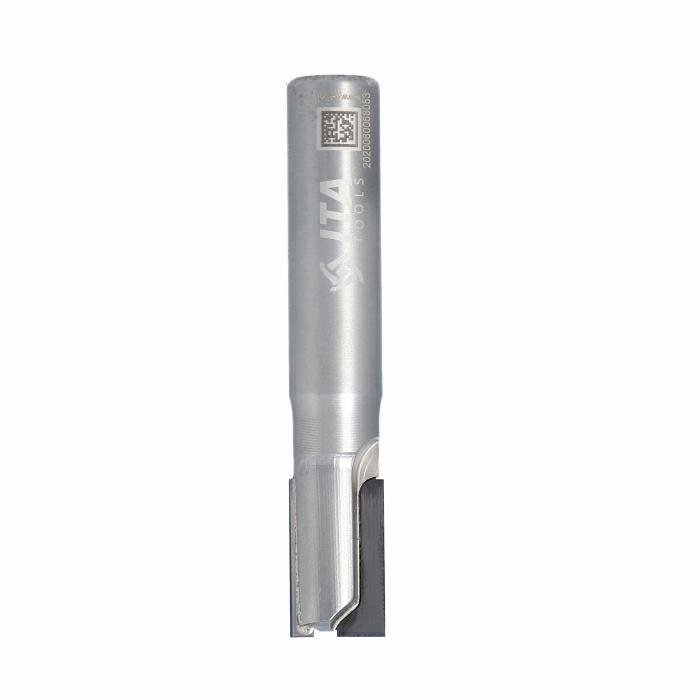
CNC Nesting Router Bits: DTE vs DTF vs DTM — Complete Guide
Complete guide to choosing CNC nesting router bits for chipboard, MDF & plywood. Expert advice on diamond vs carbide tooling for UK furniture manufacturers.
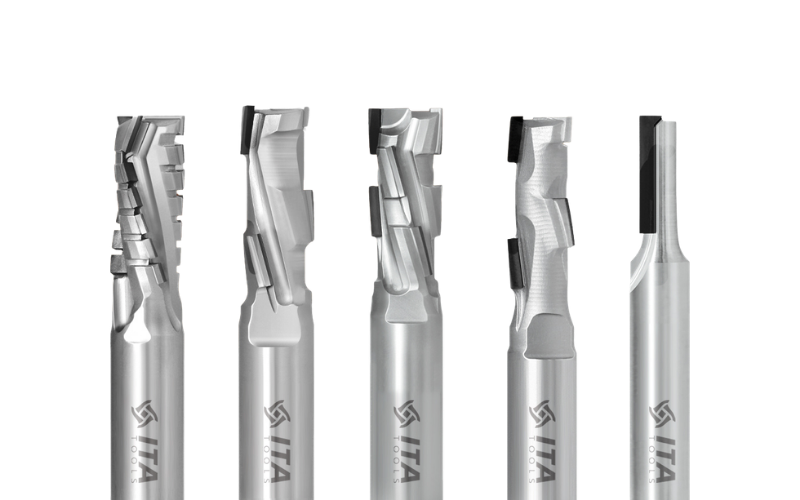
If you run a CNC nesting operation cutting laminated chipboard, MDF, or plywood, the router bit you choose determines everything: cut quality, feed rate, tool life, and ultimately your cost per panel. Yet most UK furniture manufacturers either overspend on premium tooling they cannot fully utilise, or underinvest and waste time on slow cuts and frequent tool changes.
This guide draws on over 25 years of hands-on experience in CNC panel processing and thousands of router bits tested across London's furniture manufacturing workshops. We will walk through every major nesting bit type, explain which material each one is designed for, and help you match tooling to your actual production speed and volume.
Key Takeaways
- For laminated chipboard nesting at 15–20 m/min: DTE (Z3+1) or DTF (Z2+2) are the best value options
- For MDF nesting: DTF series provides optimal dust evacuation to prevent burning
- For high-speed chipboard nesting at 20–30 m/min: DTM (Z3+3) delivers maximum performance
- Compression bits (X90/X99) offer a cost-effective alternative to diamond at roughly 40% of the price
What Is CNC Nesting and Why Does Tooling Matter So Much?
CNC nesting is the process of cutting multiple furniture parts from a single sheet of board material using an automated router. Rather than cutting one piece at a time on a panel saw or sliding table saw, a nesting machine optimises the layout of all components across the full sheet, minimising waste and eliminating manual handling between operations.
In a typical UK furniture workshop processing laminated chipboard from Egger or Kronospan, the nesting router bit is in constant contact with abrasive melamine laminate and dense particle board. A single bit might cut 500 to 2,000 linear metres before requiring replacement. The wrong tool choice does not merely produce poor-quality edges — it forces you to slow down, increases your cost per panel, and creates bottlenecks that ripple through your entire production schedule.
The critical factors that separate nesting bits are the number and geometry of cutting edges (flutes), the material they are made from (PCD diamond or tungsten carbide), and their chip evacuation capacity. Let us examine each category.
Diamond (PCD) Nesting Router Bits: The Professional Standard
Polycrystalline diamond (PCD) router bits are the industry standard for high-volume CNC nesting. Diamond tips outlast carbide by a factor of 20 to 30 in abrasive materials like melamine-faced chipboard. Although the initial purchase price is three to five times higher than carbide, the total cost per metre cut is significantly lower for any production running more than a few hundred sheets per month.
DTE Series — The Universal Nesting Workhorse
| Configuration | Z3+1 (three full PCD cutting edges on three spirals, plus one drilling tip) |
| Recommended feed rate | 15–20 m/min (tested up to 22 m/min by experienced operators) |
| Recommended RPM | 20,000–21,000 for 12 mm diameter |
| Best for | Mixed production — laminated chipboard, MDF, and plywood in the same workshop |
| Reference product | DTE.12.022.12.0DR (12 mm diameter, our best-selling nesting bit) |
The DTE is the most versatile nesting bit in the range. If your workshop processes a mix of materials and you need a single tool that handles everything competently, this is the starting point. It will not set speed records in any single material, but it cuts cleanly across chipboard, MDF, and plywood without requiring tool changes.
The DTE Z3+1 in 12 mm diameter is the single best-selling nesting router bit across the UK and European markets, and for good reason: it works in virtually every scenario. For workshops running at moderate feed rates of 15 to 17 metres per minute, the DTE delivers excellent edge quality with long tool life.
One important consideration: if your CNC runs at feed rates below 15 m/min, the DTE is actually a better value choice than the more expensive DTM, because the DTM needs higher speeds to justify its premium geometry.
DTF Series — The MDF Specialist
| Configuration | Z2+2 (two full PCD cutting edges on four spirals) |
| Recommended feed rate | 12–18 m/min |
| Best for | MDF processing, also performs well in laminated chipboard at moderate speeds |
| Reference product | DTF.12.021.12.0DRN |
MDF presents a unique challenge for router bits. The material produces extremely fine dust rather than chips, and this dust can pack into the flute spaces of a standard nesting bit, generating heat and causing burn marks on the cut surface. The DTF addresses this by using fewer cutting edges (two instead of three) but spreading them across four spirals, creating significantly more space for dust evacuation.
If your primary material is MDF, the DTF is the clear first choice. It also performs well in laminated chipboard, especially at feed rates in the 15–17 m/min range. Several of our UK clients who process predominantly Egger laminated chipboard at these moderate speeds use the DTF rather than the DTM, achieving excellent results at a lower tool cost.
The DTF typically costs £20–25 less per unit than the DTM, which translates to meaningful savings across a year of production. For perspective: the equivalent Leitz nesting bit sells for approximately £350 in the UK, while the ITA Tools DTF delivers comparable performance at around £100–120.
DTM Series — Maximum Performance for Chipboard
| Configuration | Z3+3 (three full PCD cutting edges, three spirals, optimised for high feed rates) |
| Recommended feed rate | 20–30 m/min (tested up to 40 m/min in controlled conditions) |
| Recommended RPM | 20,000–24,000 for 12 mm diameter |
| Best for | High-volume laminated chipboard nesting, both laminated and unlaminated particle board |
| Reference product | DTM.12.021.12.1DRN |
The DTM is the performance flagship for chipboard nesting. Its geometry is optimised for the larger chip sizes produced when cutting particle board, with generous flute spaces that allow efficient chip evacuation even at feed rates exceeding 25 metres per minute. With proper clamping in a thermal shrink-fit toolholder (HSK63F) and adequate dust extraction, this tool can sustain 30+ m/min in production.
However — and this is critical — the DTM only makes economic sense if your CNC can actually run at 20 m/min or above. At lower feed rates, the DTM's aggressive geometry is underutilised, and you are paying a premium for performance you cannot access. If your machine runs at 15–17 m/min, you will get better value from the DTE or DTF.
This is one of the most common mistakes we see in UK workshops: operators invest in premium DTM tooling because it is "the best," then run it at 15 m/min on a machine that cannot go faster. The result is an expensive tool that lasts no longer than a mid-range alternative. As one of our ITA Tools technicians puts it: at those speeds, you are wasting money on a tool whose potential you cannot unlock.
Best Nesting Bit for Laminated Chipboard UK: The Practical Answer
This is the question we hear most from UK workshops processing Egger, Kronospan, or similar melamine-faced particle board. The answer depends entirely on your feed rate:
At 15–17 m/min: Go with the DTE (Z3+1) for mixed production, or the DTF (Z2+2) if you want slightly longer tool life at these speeds. Both deliver excellent edge quality on laminated chipboard. The DTF has fewer cutting edges but more chip space, which can extend tool life at moderate feed rates.
At 20+ m/min: The DTM (Z3+3) is the clear winner. Its three-plus-three geometry is purpose-built for the chip loads generated at these speeds in particle board. Below 20 m/min, the DTM is overkill.
Budget option: The X99 compression bit at around 40% of the price of diamond. Tested at 20,000 RPM and 20 m/min with results that surprised even our tool technicians.
| Quick Comparison: DTE vs DTF vs DTM | |||||
|---|---|---|---|---|---|
| Series | Config | Best Material | Rec. Feed Rate | RPM (12 mm) | When to Choose |
| DTE | Z3+1 | Mixed / Universal | 15–20 m/min | 20–21k | Mixed production, moderate speeds |
| DTF | Z2+2 | MDF (also chipboard) | 12–18 m/min | 18–21k | MDF focus, or chipboard at <17 m/min |
| DTM | Z3+3 | Chipboard (lam/unlam) | 20–30 m/min | 20–24k | High-volume chipboard, fast machines |
Carbide Compression Bits: The Cost-Effective Alternative
Not every workshop needs diamond tooling. If your volumes are lower, your budgets are tight, or you simply want to test CNC nesting before committing to premium tooling, solid carbide compression router bits offer excellent performance at a fraction of the cost.
What Is a Compression Router Bit? The Crossover Point Explained
Compression router bits combine upcut and downcut spirals in a single tool. The lower portion has a positive (upcut) spiral that pushes chips upward, while the upper portion has a negative (downcut) spiral that pushes chips downward. The result: clean edges on both the top and bottom faces of the panel, with no chipping on either side.
The critical dimension is the crossover point (known as "i1" in the specifications) — the height where the upcut and downcut spirals intersect. This crossover point must always sit below the top surface of your material. For example, if you are cutting 18 mm chipboard, an i1 value of 4.5 mm means the crossover is well below the surface, ensuring clean compression cutting on both faces. If the i1 were 20 mm and your board only 18 mm thick, the compression effect would be lost entirely — always check this specification against your material thickness.
X90 and X99 Compression Series
X90 series: Standard compression geometry with enhanced carbide grade. Reliable performance in chipboard and MDF. Available from 8 mm diameter upward.
X99 series: The latest generation featuring Z2+6 geometry and Platinium coating (dual-layer: tribological for reduced friction + hardening for wear resistance). Field testing has delivered exceptional results — clients running X99 bits at 20,000 RPM and 20 m/min report tool life approaching diamond in many applications, including laminated chipboard.
At roughly 40% of the price of a diamond nesting bit (around £100 per bit), the X99 compression series is becoming a serious alternative for workshops that do not want to invest in PCD tooling. One ITA Tools technician we work closely with noted that X99 test results have been so consistently strong — running four shifts without interruption at one client site — that it genuinely raises the question of whether diamond is necessary for standard chipboard nesting at moderate speeds.
Entry-Level Diamond Bits: DTA, DTB, DTN, and DTL
Before committing to dedicated nesting tooling, many workshops start with simpler diamond router bits for basic panel cutting. These tools are not designed for high-speed nesting, but they provide an affordable introduction to diamond tooling.
DTA (Z1+1): The most basic diamond router bit. One full PCD edge on one spiral. Suitable for simple crosscutting at up to 5 m/min. Costs around £50 and serves as an ideal entry point for workshops transitioning from carbide to diamond. Available in three variants:
- DTA standard — carbide body with axial cutting angles, functioning similarly to a basic DTS.
- DTA.V (VSR) — with drilling tip (steel body, 45° PCD plunge tip). Allows direct plunging into the material.
- DTA.B (BSR) — with bottom bearing for template work.
DTB (Z1.5+3, Pro Series): An enhanced version of the DTA with an additional diamond tooth, more aggressive axial angles, and a modified body for better chip evacuation. The cheapest diamond solution that can cut plywood cleanly. The price difference versus the DTA is minimal, but performance is noticeably better. We sell these in hundreds — they are a proven workhorse.
DTN (Z2+2): Two full cutting edges on four spirals. Essentially a doubled DTA that enables higher feed rates and can handle light nesting at 10–12 m/min.
DTL (Pro Series): The enhanced version of the DTN with a diamond drilling tip, more aggressive axial angles, and improved chip evacuation.
Specialty Nesting and Finishing Tools
DTE TURBO — Contour Finishing and Edge Trimming
The DTE TURBO features three full PCD cutting edges on three spirals. Its distinctive design uses small inserts with large chip gullets — a different construction from the standard DTE.
The DTE TURBO is designed for contour finishing: trimming the edges of panels that have been rough-cut by a saw and may have ragged edges. The workpiece is clamped on a block-type CNC table and the bit finishes the edge at very high feed rates. While some operators use it for through-cutting, this is not its intended application — dedicated nesting bits like DTE, DTF, or DTM are better suited for panel nesting.
DTE TURBO Nesting — Plywood Specialist
This is a modification between the standard DTE and the DTE TURBO. It features three full PCD inserts on three spirals — the inserts are not as large as on the standard nesting DTE, but not as small as on the DTE TURBO.
This variant was developed in response to customer demand for plywood machining. It is most commonly used for plywood nesting. With cutting lengths up to 35 mm, it can cut 32–33 mm panels in a single pass. It is also suitable for other thicker materials.
DTS — The Most Universal Diamond Router Bit
The DTS (DTS.12.020.12.0DR) features two full PCD inserts positioned on opposing axial angles — one positive, one negative. During each revolution, the bit cuts cleanly on both the top and bottom faces simultaneously. This makes it the most versatile single tool in the diamond range.
The DTS handles MDF, chipboard (laminated and plain), plywood, solid wood, all plastics including Corian and HPL, fibreglass, fibre cement, and carbon fibre. It is particularly recommended as the ideal solution for cutting HPL, Corian, and other homogeneous solid surface materials.
DTC — For Difficult Laminates and Paper-Faced Boards
The DTC is a modified contour finishing tool with 35-degree axial angles (compared to 25 degrees on the standard DTE). This more aggressive geometry is specifically designed for thin or paper-based laminates that tend to chip or delaminate during edge finishing.
This is not a standard solution for every workshop. It is a targeted tool for operators who consistently work with difficult laminates and need cleaner edge results than the standard DTE TURBO can deliver.
How to Choose: A Decision Framework
Selecting the right nesting bit comes down to three questions: what material are you cutting, how fast is your machine, and what is your monthly volume?
| Decision Framework | |||
|---|---|---|---|
| Your Situation | Feed Rate | Budget | Recommended Tool |
| Mixed materials, moderate volume | 15–17 m/min | Mid-range | DTE (Z3+1) |
| Primarily MDF | 12–18 m/min | Mid-range | DTF (Z2+2) |
| Chipboard, high volume | 20–30 m/min | Premium | DTM (Z3+3) |
| Any material, budget-conscious | 15–20 m/min | Economy | X99 Compression |
| HPL / Corian / Solid Surface | 10–15 m/min | Mid-range | DTS (Z2 axial) |
| Difficult / paper laminates | 15–20 m/min | Mid-range | DTC (35° axial) |
| Testing diamond for first time | 5–10 m/min | Entry | DTA or DTB |
| Recommended Feed Rates and RPM Settings | ||||
|---|---|---|---|---|
| These values are based on real production data from UK workshops using ITA Tools nesting bits in laminated chipboard. | ||||
| Series | Feed Rate Range | Sweet Spot | RPM (12 mm) | Notes |
| DTE | 10–22 m/min | 15–17 m/min | 20–21k | Universal, best value at moderate speeds |
| DTF | 8–18 m/min | 12–15 m/min | 18–21k | Ideal for MDF; chipboard OK at <17 m/min |
| DTM | 15–40 m/min | 20–25 m/min | 20–24k | Only economical above 20 m/min |
| X99 | 10–20 m/min | 15–20 m/min | 18–20k | Best carbide alternative to diamond |
| DTS | 5–15 m/min | 10–12 m/min | 18–20k | Universal; best for HPL/Corian |
Common Mistakes to Avoid
- Buying DTM for a slow machine: The DTM is designed for 20+ m/min. Running it at 15 m/min wastes money — you will get equal or better results from a DTF at a lower price point. We see this mistake regularly in UK workshops.
- Using standard carbide spirals in MDF: MDF is extremely abrasive. Standard tungsten carbide spiral bits wear out rapidly. For MDF work, either use diamond (DT series) or the X90/X99 compression bits with enhanced carbide and coatings. As our ITA Tools technician confirms: in MDF, it is diamond or nothing for serious production.
- Ignoring the crossover point (i1) on compression bits: The intersection must always be below your material's top surface. Always check the i1 specification against your material thickness before ordering.
- Choosing by brand name instead of application: We regularly see workshops paying £300–350 for branded European nesting bits when equivalent ITA Tools solutions cost £100–120 and deliver comparable performance.
- Overlooking dust extraction: The best nesting bit in the world will underperform with poor dust extraction. Before upgrading tooling, ensure your extraction system is clean, the hose is not blocked, and airflow is adequate.
Frequently Asked Questions
How long does a diamond nesting router bit last?
In laminated chipboard at recommended feed rates, a quality PCD nesting bit typically cuts 3,000 to 8,000 linear metres before requiring resharpening. Tool life depends heavily on material type, feed rate, machine condition, and dust extraction efficiency. Most resharpened bits achieve 80–90% of original tool life.
Can I use the same router bit for chipboard and MDF?
Yes — the DTE series is designed for exactly this purpose. However, if one material dominates your production (say 80%+ MDF), you will get better results with a dedicated solution like the DTF for MDF or DTM for chipboard.
What RPM should I run nesting router bits at?
Most 12 mm diameter nesting bits run optimally at 20,000–21,000 RPM in laminated chipboard. Smaller diameters may run faster, larger diameters slower.
Is a thermal shrink-fit holder really necessary?
For DTM-level performance at 20+ m/min, thermal shrink-fit holders (HSK63F) provide the runout accuracy and clamping force needed. For moderate-speed work with DTE or DTF bits, ER collet holders are perfectly adequate.
How do compression bits compare to diamond for nesting?
The latest X99 compression bits with Z2+6 geometry and Platinium coating deliver surprisingly competitive results — especially in laminated chipboard at moderate feed rates. At roughly 40% of the price of diamond, they are an excellent choice for lower-volume production.
Need help choosing the right nesting router bit for your production?
Browse our complete range of CNC nesting tools or contact us for a free tooling consultation. With 25+ years of CNC experience across London's furniture industry, we will match the right tool to your machine, material, and budget.