
Diamond vs Carbide Router Bits: When to Switch and Why It Pays for Itself
Diamond PCD router bits vs carbide — real cost analysis, tool life data & practical switching guide for UK furniture manufacturers. Save 80% per cut.
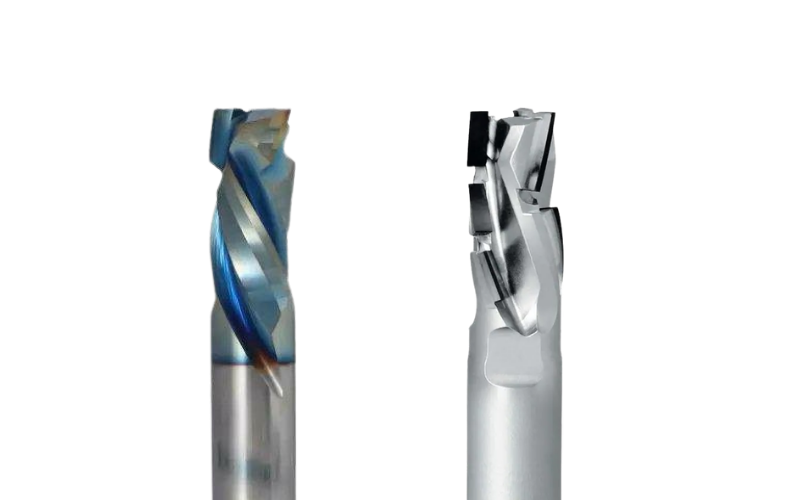
Every CNC operator in UK furniture manufacturing faces this question sooner or later: is diamond tooling worth the investment, or is carbide good enough? The answer is not as simple as "diamond is better" — it depends on your materials, volumes, and how you calculate cost.
After 25 years of experience in CNC technology — from operating machines and programming to consulting workshops across the UK — here is the honest breakdown based on real production data from our customers. Diamond is not always the right choice. But when it is, the savings are dramatic — we are talking about a 90% reduction in cost per linear metre cut.
This guide walks you through the real numbers, the materials where each type excels, and a clear decision framework so you can stop guessing and start saving.
The fundamental difference: what PCD diamond actually is
Polycrystalline diamond (PCD) is not a natural gemstone mounted on a tool. It is a synthetic material manufactured under extreme heat and pressure, fusing microscopic diamond particles onto a tungsten carbide substrate. This composite is then laser-cut into precise insert shapes and brazed onto a steel or carbide tool body.
The result is a cutting edge with a Vickers hardness of approximately 8,000 HV — roughly 8 to 12 times harder than standard tungsten carbide (which sits at around 1,000–1,500 HV). That hardness difference is why PCD router bits last 20 to 30 times longer than carbide in abrasive materials like melamine-faced chipboard and MDF.
Carbide router bits, by contrast, use solid tungsten carbide throughout (for spiral bits) or tungsten carbide tips brazed onto a steel body (for tipped bits). Carbide is tough, relatively inexpensive, and can be manufactured in complex geometries that PCD cannot easily replicate — particularly multi-flute spiral designs with tight helical angles.
Tool life: the numbers that matter
The most important comparison is not purchase price — it is cost per metre of material cut. Here is what we consistently see across UK production workshops:
In laminated chipboard (Egger, Kronospan):
A quality carbide compression bit (like the ITA Tools X90) typically cuts 150–400 linear metres before the edge degrades noticeably. A PCD nesting bit (like the DTE Z3+1) cuts 3,000–8,000 linear metres before requiring resharpening. That is a ratio of roughly 20:1 to 30:1 in favour of diamond.
In MDF:
Carbide wears even faster in MDF due to the extremely fine, abrasive dust. Expect 100–250 linear metres from a standard carbide spiral. A PCD bit like the DTF will deliver 2,000–5,000 linear metres. The ratio can exceed 30:1 in MDF — this is where diamond makes the strongest economic case.
In plywood:
Plywood is harsh on all tooling because of alternating grain directions and adhesive layers. Carbide delivers 100–300 linear metres depending on species and adhesive. PCD delivers 1,500–4,000 metres. The ratio is roughly 15:1 to 20:1.
In solid wood:
This is where the picture changes. Solid wood (especially softwoods) is far less abrasive than engineered board materials. Carbide can deliver 500–2,000+ linear metres in pine or oak. PCD still lasts longer, but the ratio drops to perhaps 5:1 or 10:1 — and the cost premium of PCD may not be justified for many solid wood applications.
The real cost comparison: diamond pays for itself faster than you think
Let us work through an actual example using prices from our UK stock:
Scenario: Nesting laminated chipboard at 15 m/min
| Factor | Carbide (X90 compression) | Diamond (DTE Z3+1) |
|---|---|---|
| Purchase price | ~£85 | ~£200 |
| Tool life (linear metres) | ~300 m | ~5,000 m |
| Resharpenings available | 0–1 | 3–4 |
| Total lifetime metres | ~400 m | ~18,000 m |
| Cost per linear metre | £0.213 | £0.011 |
| Saving with diamond | — | ~95% |
Even being conservative with the numbers, diamond tooling reduces per-metre cutting costs by 90–95% in laminated chipboard. The break-even point — where the higher diamond purchase price is offset by longer life — typically occurs within the first 900–1,100 linear metres. For most UK workshops cutting panel furniture, that is three to five days of production.
The savings are even more dramatic in MDF, where carbide wears faster and the ratio stretches further in diamond's favour.
When carbide is the better choice
Diamond is not always the answer. Here are the scenarios where carbide makes more economic sense:
Low-volume or mixed-material workshops. If you cut fewer than 50 sheets per month, the absolute savings from diamond may not justify the higher upfront cost, especially if your production is intermittent.
Complex geometries that PCD cannot replicate. Multi-flute solid carbide spiral bits with tight helical angles, ball-nose cutters for 3D carving, and specialised profile bits are often only available in carbide. PCD inserts are brazed onto the body in specific positions, limiting geometry options.
Solid wood dominant production. If 80%+ of your work is solid timber (kitchens, joinery, furniture from oak/ash/walnut), the carbide-to-diamond tool life ratio is lower, and carbide's availability in more geometries makes it the practical choice.
Entry-level CNC or testing phase. If you are just setting up a CNC or testing a new production process, start with carbide to dial in your parameters before investing in diamond. An £85 mistake teaches the same lesson as a £200 one.
Budget constraints with immediate production needs. Two carbide bits for roughly the price of one diamond gives you redundancy. If cash flow is tight and you need to keep cutting today, carbide gets you running faster.
When to switch to diamond: the decision framework
The switch to diamond makes clear economic sense when you meet most of these criteria:
You cut engineered board materials — chipboard, MDF, plywood, or HPL. These materials are abrasive and destroy carbide quickly. The worse the material is for carbide, the better the case for diamond.
Your monthly volume exceeds 100 sheets. At this volume, you will typically go through 2–4 carbide bits per month. One diamond bit will last several months.
Your CNC runs at consistent feed rates above 10 m/min. Diamond tooling performs best in continuous, steady cutting. Stop-start operation with frequent plunging is harder on PCD inserts.
You value consistent edge quality. Carbide starts degrading from the first cut. The finish gets progressively worse until the bit is replaced. Diamond maintains a consistent finish throughout its life — the quality only drops sharply when the bit is truly worn, at which point it needs resharpening.
You can access resharpening services. A PCD bit that has been resharpened 3–4 times delivers dramatically more lifetime value. Each resharpening costs roughly 30–40% of a new bit's price and restores 80–90% of original performance.
The ITA Tools diamond range: where to start
If you are transitioning from carbide to diamond, here is the progression we recommend for UK furniture manufacturers:
Step 1 — Test with DTA (Z1+1, ~£35–45). The cheapest diamond router bit available. One PCD insert on one spiral. Not fast — maximum 5 m/min — but it demonstrates the tool life advantage at minimal risk. Use it for basic crosscutting and compare wear against your current carbide.
Step 2 — Upgrade to DTB Pro (Z1.5+3, ~£49). More aggressive geometry, better chip evacuation. The cheapest diamond option that cuts plywood cleanly. A genuine working tool, not just a test piece.
Step 3 — Move to DTE for nesting (Z3+1, ~£200). The universal nesting workhorse. If you are doing any volume of panel work, this is where the real savings begin. The DTE handles chipboard, MDF, and plywood — your one tool for mixed production.
Step 4 — Specialise with DTF (MDF) or DTM (chipboard). Once you know your primary material and production speed, move to the dedicated solution. DTF for MDF-dominant workshops, DTM for high-speed chipboard operations above 20 m/min.
For a detailed comparison of DTE vs DTF vs DTM, see our complete CNC nesting router bits guide.
The X99 wildcard: carbide that punches above its weight
One development that is reshaping the diamond-vs-carbide debate is the ITA Tools X99 compression series. These are not standard carbide bits — they feature a proprietary harder carbide grade with significantly less cobalt content, a Z2+6 geometry for optimised chip evacuation, and a dual-layer Platinium coating (tribological + hardening).
Field test results have been remarkable. Workshop trials at 20,000 RPM and 20 m/min in laminated chipboard showed the X99 approaching diamond-level tool life in many scenarios — at roughly one-third the purchase price. One test client ran X99 bits through four consecutive shifts without interruption.
The X99 does not fully replace diamond in high-volume, high-speed operations where DTM-level performance is needed. But for workshops operating at moderate speeds (15–20 m/min) in laminated chipboard, the X99 represents an extraordinary value proposition that blurs the line between carbide and diamond performance.
For more on compression bits including the X99, see our guide: What Is a Compression Router Bit and When Should You Use One?
Handling and maintenance: protecting your investment
Diamond tooling lasts dramatically longer than carbide, but it is also more brittle. PCD inserts can chip or crack if subjected to impact, incorrect handling, or inappropriate cutting conditions. Here are the essential care practices:
Never drop a PCD bit on a hard surface. The diamond inserts are brazed onto the tool body and can crack on impact. Store bits vertically in dedicated holders or foam-lined cases.
Use proper toolholders. For high-speed nesting (20+ m/min), thermal shrink-fit holders (HSK63F) provide the runout accuracy and clamping force that PCD requires. At moderate speeds, ER collets are adequate — but check runout regularly.
Do not push a dull diamond bit. Unlike carbide, which degrades gradually, PCD maintains its edge until it drops sharply. When you notice increased spindle amps or degrading finish quality, pull the bit immediately. Continuing to run a dull PCD bit can shatter the diamond face, turning a £60 resharpening into a £200 replacement.
Ensure adequate dust extraction. Packed chips generate heat that accelerates wear on any tooling. Verify your extraction system is clean and airflow is unobstructed before blaming the tool.
Track your tool life. Keep a simple log of linear metres cut per bit. This data tells you exactly when to swap tools and makes your resharpening schedule predictable.
Common myths about diamond tooling — debunked
"Diamond bits are too fragile for production." Modern PCD inserts are engineered for industrial nesting at 20–30 m/min. They are used in thousands of production lines worldwide. Fragility was a valid concern 20 years ago — it is not today.
"You need a high-end CNC to use diamond." Any CNC router with a standard ER collet or HSK toolholder can run PCD bits. The entry-level DTA works at just 5 m/min — slower than most machines' minimum practical speed.
"Carbide gives a better edge finish than diamond." This is true only for the first few metres. Carbide degrades continuously from cut one. Diamond maintains consistent finish quality for thousands of metres. Over a production run, diamond delivers far more consistent quality.
"Diamond tooling only makes sense for large factories." With entry-level PCD bits starting at ~£35–45, even small workshops can test diamond. The DTA Z1+1 costs less than a premium carbide spiral bit from many brands.
"Brand-name diamond bits are worth the premium." We regularly see workshops paying £400–500 for branded European PCD nesting bits. ITA Tools equivalents deliver comparable performance at £200. The premium buys a logo, not additional cutting capability — and with two ITA Tools bits at the same budget, you get far more total cutting life.
Frequently Asked Questions
How much longer do diamond router bits last than carbide?
In engineered board materials (chipboard, MDF, plywood), PCD diamond bits typically outlast carbide by a factor of 20 to 30. In solid wood, the ratio is lower — roughly 5 to 10 times. The exact ratio depends on the specific material, feed rate, RPM, and dust extraction quality.
What is the break-even point for switching to diamond?
In laminated chipboard at typical UK production rates, the break-even occurs within 900–1,100 linear metres — roughly three to five days of regular nesting production. After that point, every additional metre cut with diamond is significantly cheaper than carbide.
Can diamond router bits be resharpened?
Yes — this is one of their biggest advantages. A quality PCD nesting bit can be resharpened 3–4 times, with each resharpening restoring approximately 80–90% of original tool life. Resharpening typically costs 30–40% of a new bit's price. Total lifetime value including resharpenings can be 3–4 times the initial purchase.
Why is diamond not good for solid wood?
Diamond works fine in solid wood — it just does not offer the same dramatic cost advantage. Solid wood is less abrasive than engineered boards, so carbide lasts longer relative to diamond. Combined with diamond's higher purchase price and limited geometry options for profiling, carbide often makes more practical sense for solid wood work.
Is there a middle ground between carbide and diamond?
Yes — coated carbide compression bits like the ITA Tools X99 series (with Z2+6 geometry and Platinium dual-layer coating) deliver tool life approaching diamond in many applications, at roughly one-third the cost. They are ideal for workshops not ready to commit fully to diamond tooling.
Do I need to change my CNC settings when switching from carbide to diamond?
Generally, you can run PCD bits at the same or similar feed rates and RPM as carbide. The main adjustment is monitoring tool life — diamond lasts so much longer that operators sometimes forget to check edge quality. Establish a checking schedule based on linear metres rather than time.
Ready to test diamond tooling in your workshop? Start with an ITA Tools DTA at ~£35–45 and see the difference yourself. Browse our complete diamond router bit range at smarterproduction.co.uk, or contact us for a free cost analysis comparing your current carbide spend against diamond alternatives. We will calculate your exact break-even point and projected annual savings.


