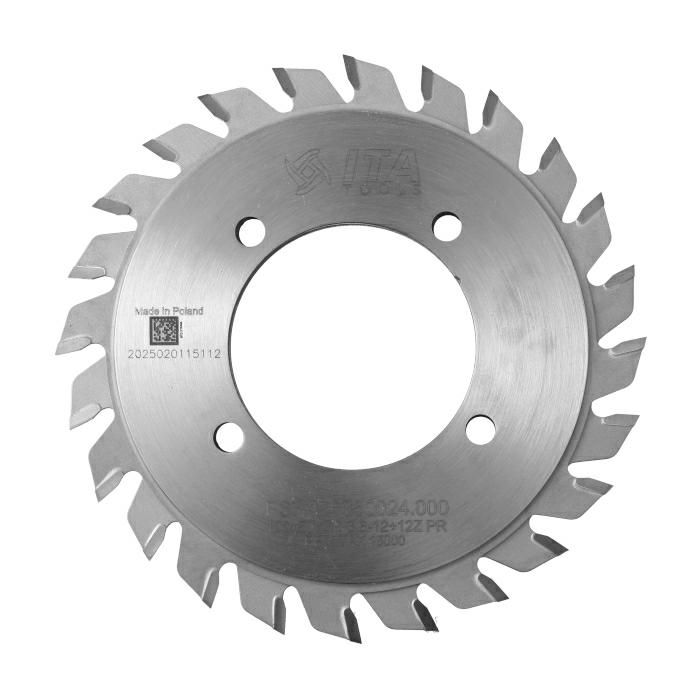
What Does a Scoring Blade Actually Do?
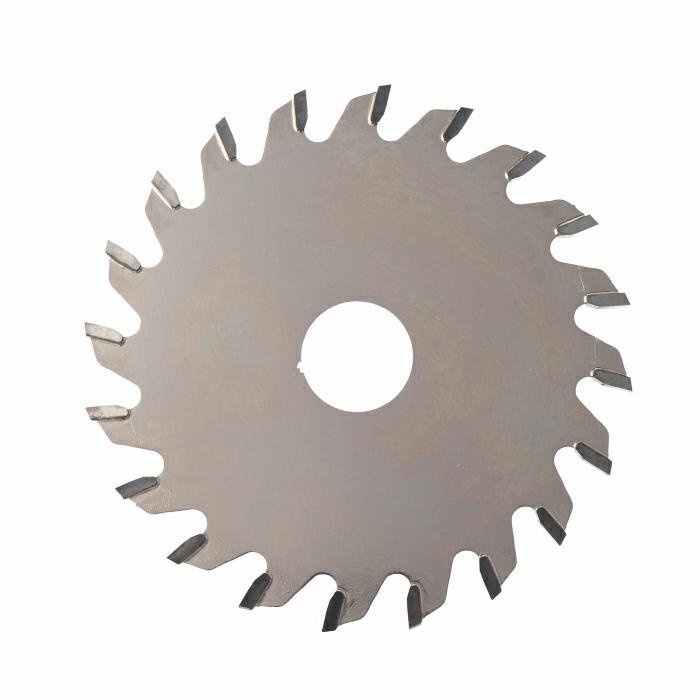
A scoring blade is a small-diameter saw blade (typically 80–160 mm) mounted ahead of the main blade on a panel saw or beam saw. It rotates in the opposite direction to the main blade and makes a shallow cut (1.5–2.5 mm deep) on the underside of the panel before the main blade cuts through from above.
Without scoring, the main blade tears through the bottom laminate layer as it exits — causing chipping. The scoring blade pre-cuts that exit point cleanly, so both faces of the panel remain chip-free.
Key principle: the scoring blade kerf must be 0.1–0.2 mm wider per side than the main blade kerf. Too narrow = chipping persists. Too wide = visible score line on the finished edge.
Three Types of Scoring Blades
These are the standard scoring systems found on machines common in UK workshops — Felder K series, Altendorf F45, SCM Sigma, and beam saws from Homag and Biesse.
1. Split Scoring Blades (Shim-Adjustable)
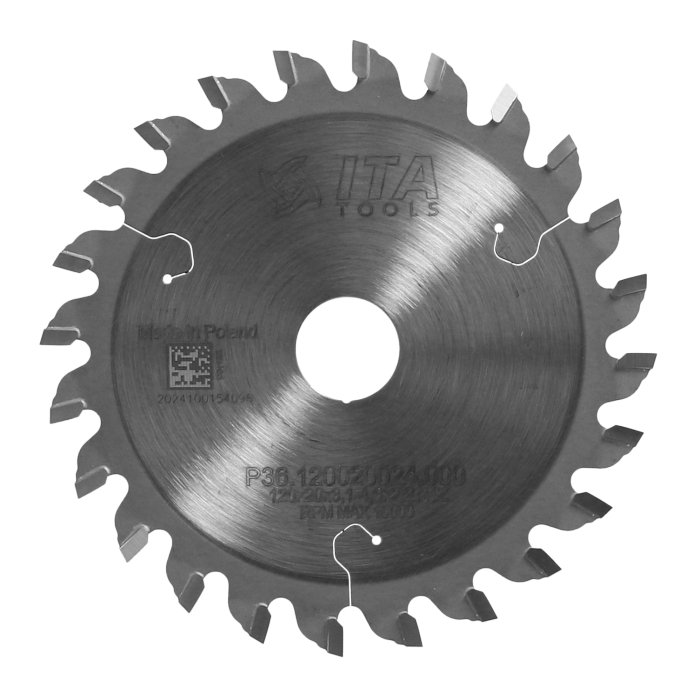
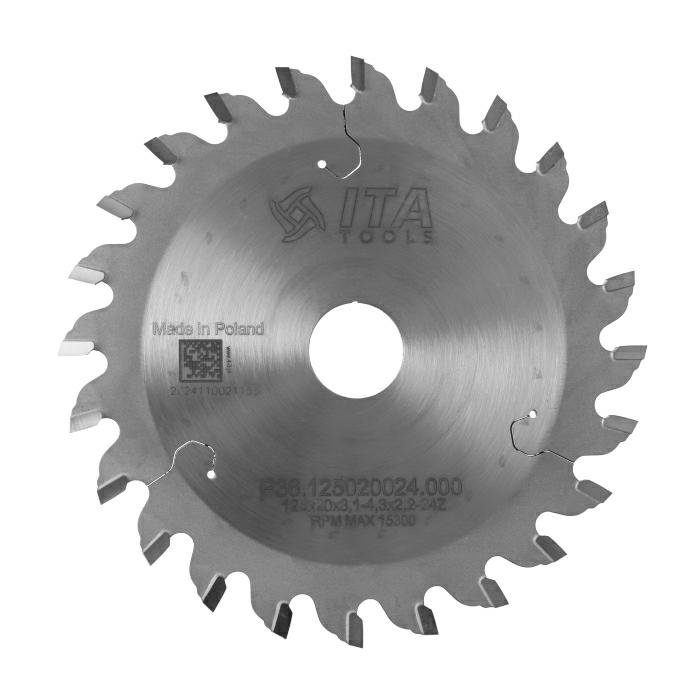
The most common type. Two blade halves separated by shims (spacer rings) to set the kerf width. To change the width, you remove the blade from the machine, add or remove shims, and reinstall.
| Parameter | Typical value |
|---|---|
| Adjustment range | 3.0–4.8 mm (depends on shim set) |
| Adjustment method | Shims — requires removal from machine |
| Setup time | 5–15 minutes |
| Price range | £35–£90 |
| Typical diameters | 100, 120, 125 mm |
Advantages: Lowest cost. Wide adjustment range covers most main blade kerfs. Universal — fits nearly all panel saws with a scoring unit (Altendorf, Felder, SCM, Holzher, Griggio).
Disadvantages: Slowest to adjust — every width change means stopping the machine, removing the blade, swapping shims, and re-checking alignment. In a workshop that changes main blades frequently (e.g. switching between 3.2 mm and 4.4 mm kerf), this costs real production time.
Best for: Small to medium workshops running the same main blade for long periods.
2. Conical Scoring Blades
These have tapered (cone-shaped) teeth. The kerf width changes automatically based on how deep the blade cuts — raise it higher into the material for a wider kerf, lower it for a narrower one. No shims, no disassembly.
| Parameter | Typical value |
|---|---|
| Adjustment range | 2.8–3.6 mm (varies by model) |
| Adjustment method | Blade height — no removal needed |
| Setup time | 1–2 minutes (height adjustment only) |
| Price range | £45–£120 |
| Typical diameters | 100, 120, 125, 150, 160 mm |
Advantages: Fast adjustment without removing the blade. Excellent cut quality on flat, stable panels — melamine and HPL laminates come out very clean. Longer tooth life than split blades due to the robust tapered geometry.
Disadvantages: Narrower adjustment range than split blades — if your main blade kerf falls outside the conical range, you're stuck. More sensitive to warped or bowed panels: on an uneven sheet, the varying contact depth means the kerf width changes across the cut, leaving inconsistent edges. Not ideal for workshops cutting a wide range of panel thicknesses.
Best for: High-volume panel processing where sheets are flat and the main blade kerf stays within the conical range. Common in beam saws (Homag, Biesse, SCM) running long batches.
3. On-Machine Adjustable Scoring Blades (Dial System)
A mechanical dial or screw mechanism allows you to change the kerf width while the blade stays mounted on the machine. Turn the dial, make a test cut, done.
| Parameter | Typical value |
|---|---|
| Adjustment range | 2.8–4.6 mm (widest range) |
| Adjustment method | Dial/screw — on the machine |
| Setup time | 30–60 seconds |
| Price range | £120–£350+ |
| Typical diameters | 100, 120, 125 mm |
Advantages: Fastest setup by far. No blade removal, no shims, no height guesswork. Pays for itself in workshops that change main blades frequently or run mixed production (different panel brands with different laminate thicknesses).
Disadvantages: 2–3× the price of a split blade. The mechanical adjustment adds moving parts that can wear over time. Some cheaper models lose precision after repeated adjustments.
Best for: Medium to large production workshops with frequent blade changes. If you're running 2–3 different main blade setups per shift, the time savings justify the higher price within weeks.
Side-by-Side Comparison
| Feature | Split (Shim) | Conical | On-Machine Adjustable |
|---|---|---|---|
| Adjustment speed | 5–15 min | 1–2 min | 30–60 sec |
| Kerf range | 3.0–4.8 mm | 2.8–3.6 mm | 2.8–4.6 mm |
| Blade removal needed | Yes | No | No |
| Cut quality (flat panels) | Good | Excellent | Good |
| Cut quality (warped panels) | Good | Poor | Good |
| Price | £35–£90 | £45–£120 | £120–£350+ |
| Best for | Budget / fixed setup | Beam saws / flat stock | Mixed production |
How to Set Up a Scoring Blade Correctly
Depth: The scoring blade should cut 1.5–2.5 mm into the material — just enough to pre-score the bottom laminate layer. Going deeper wastes energy and accelerates wear without improving cut quality.
Width: Set the scoring kerf 0.1–0.2 mm wider than the main blade kerf on each side. For a 3.2 mm main blade, target 3.4–3.6 mm on the scoring blade. Use a test cut on scrap material and inspect both edges under good light before running production panels.
Lateral alignment: The scoring blade must be centred exactly on the main blade's cutting line. Even 0.3 mm of lateral offset shows as a visible step on the cut edge.
Common Mistakes
1. Scoring too deep. Cutting 4–5 mm into the panel doesn't improve the edge — it just loads the small scoring motor unnecessarily and dulls the blade faster.
2. Ignoring lateral alignment. After every blade change, check that the scoring and main blade are centred on the same line. A quick test cut catches this in seconds.
3. Running a dull scoring blade. A worn scoring blade chips the laminate instead of cleanly pre-cutting it — defeating the entire purpose. Carbide-tipped blades typically last 3–6 months in production before needing resharpening.
4. Wrong kerf width. If you change the main blade and forget to re-adjust the scoring blade, you'll either get chipping (scoring too narrow) or a visible double line on the edge (scoring too wide).
2025/2026 Trend: PCD (Diamond) Scoring Blades
PCD (polycrystalline diamond) tipped scoring blades are gaining popularity in high-volume production. They cost 4–8× more than standard carbide, but last 10–20× longer — making the cost per cut significantly lower for workshops running 8+ hours per day. If you're processing more than 50 panels daily, PCD scoring blades are worth evaluating. We stock diamond scoring blades in both split (DSB series) and adjustable (DSC series) configurations.
Our Scoring Blade Range
We stock split, conical and adjustable scoring blades in diameters from 80 to 300 mm, with bore sizes to fit all common panel saws (20 mm standard, with pin hole configurations for Altendorf, Felder, SCM and others). All blades are manufactured by ITA Tools with micro-grain carbide tips.
Popular models:
- P36.100020020.000 — Split Scoring Blade D=100 mm, Z20 — £46.23
- P36.120020024.000 — Split Scoring Blade D=120 mm, Z24 — £48.33
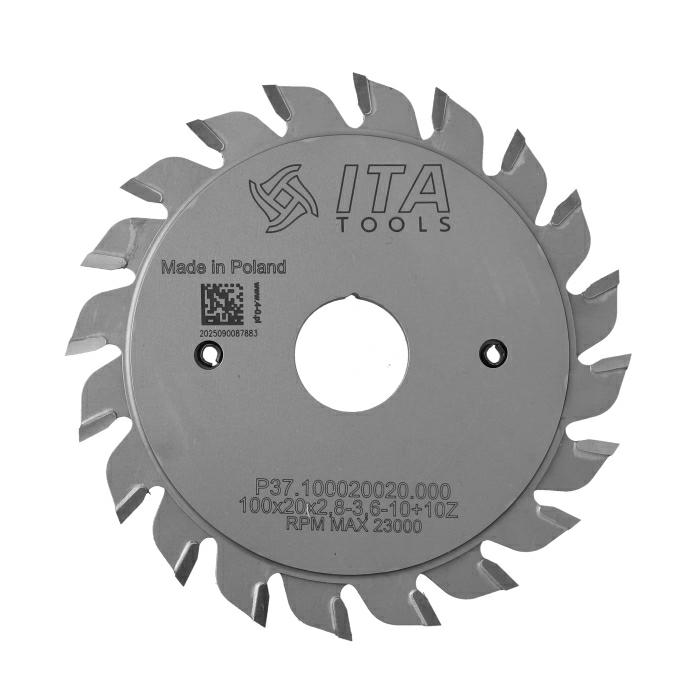
- P37.100020020.000 — Adjustable HM Scoring Blade D=100 mm, Z10+10 — £58.00
Browse our scoring blade range:
For Format Saws (Table Saws)
- P36 series — Split scoring blades for chip-free scoring on laminated panels
- P37 series — Adjustable scoring blades with spacer control for perfect kerf adjustment
- DSB series — Diamond split scoring blades, up to 50x longer tool life
- DSC series — Diamond adjustable scoring blades, up to 50x longer life vs HM
For Panel Saws / Beam Saws
- P36 series — Split scoring blades for undercutting laminated panels
- DSB series — Diamond scoring blades with PCD tips, excellent lifetime/price ratio