
First CNC Machine for Your Furniture Workshop: Choose Right or Pay Twice
Buying your first CNC for a small furniture workshop: four mistakes that cost twice, from 25 years of London implementation experience.
London has hundreds of small furniture workshops. Most are five to fifteen people, working on tight industrial floor space where getting a large machine through the door is already a challenge. And that is fine — nobody is trying to build a factory. The goal is a focused, specialist business producing bespoke kitchens, wardrobes, and fitted furniture for an extremely demanding market.
After 25 years in this industry — implementing CNC systems in workshops across London and the UK — I can say one thing with full confidence: the technology has changed beyond recognition in the last ten to twelve years. Not because machines got cheaper. Because for the same money, you get incomparably more. A machine that cost £100,000 twelve years ago and offered basic three-axis machining with poor software is now far behind what you can get for £20,000–30,000 with modern controls and full CAD/CAM integration.
The problem is that most workshops still make the same mistakes when buying their first CNC machine. This article is about avoiding them.
Key Takeaways
- Buying the wrong CNC machine costs you twice — once when you buy it, and again when you discover it cannot handle what your production actually needs. The most expensive machine is rarely the right machine.
- A CNC drilling machine at £35,000 pays for itself in under 12 months — roughly the annual salary cost of one skilled joiner in London, but it works two shifts and never calls in sick.
- For most London workshops the sweet spot is nesting + 6-sided through-feed drill + software (Variant B) — this combination handles 80%+ of bespoke kitchen and wardrobe production with a single operator.
- Software is often the biggest unlock — workshops with two CNC machines and no connecting software routinely run at 30–40% of their machine potential without realising it.
- If budget is tight, Variant A (panel saw + CNC drill + software) works — you do not need a nesting centre to achieve serious production volumes in a compact workshop.
Why Your First CNC Decision Shapes Your Workshop’s Future
I estimate that 80–90% of furniture workshops in London were started by building companies. The logic is simple: strong cashflow from construction, large bills from furniture suppliers for kitchens and fitted rooms — so why not make it in-house? Some businesses get it right. Many, especially in the first two to three years, repeat the same pattern of mistakes.
The process usually looks like this: the owner visits a machinery dealer — Felder, Homag, SCM — and meets a salesperson whose job is to sell what they stock. Not necessarily what your business actually needs. The workshop buys a CNC router for £100,000–150,000 that “does everything.” And it does — in theory. In practice, small elements like drawer sides and narrow strips do not hold on the vacuum table, and horizontal boring on a router is slow and inefficient. Next to a six-figure machine, a joiner stands with a hand drill doing exactly what the CNC was supposed to handle.
It is not the dealer’s fault. It is the result of buying without a clear production specification first.
80% of Bespoke Furniture Is Simple Boxes — and That Changes Everything
This sounds controversial, but it comes from years of watching real production floors. Even on high-end projects — kitchens and fitted rooms worth £150,000–200,000 — approximately 80% of the physical work is simple carcasses: cabinet bodies, tops, sides, drawer components. Rectangular panels that need cutting, drilling, edging, and assembling. There can be dozens, sometimes hundreds, in a single project.
In a traditionally organised workshop, this work consumes most of a joiner’s day. And skilled joiners in London charge £250–300 per day — when you can find them.
In a well-organised CNC workshop, the split looks completely different. One operator runs the nesting machine and the CNC drill simultaneously. One or two assistants assemble the finished components — carcasses arrive like flat-pack furniture, except made to exact bespoke dimensions. The skilled joiners — the ones who are genuinely hard to find and correctly paid — work exclusively on what machines cannot do: painted fronts, applied panels, mirrors, metalwork, leather finishes, specialist hardware installation.
It is not about replacing joiners. It is about not wasting their time on things a machine does better.
The Four Configurations That Actually Work
There is no single universal path. Every workshop has a different production profile, floor layout, and budget. Below are the four configurations I have seen work consistently in practice across London and the wider UK.
Variant A — Small Workshop, Limited Space (from ~£50,000)
If the workshop cannot physically fit a large nesting centre — narrow entrance, low ceiling, restricted floor area — a good panel saw + compact 5-sided CNC drill + software delivers full production capability in minimal space. The saw cuts panels with a 2mm allowance per face. The CNC drill machines them from all five sides: drilling, routing, grooving. One person on the saw, one on the drill. Joiners receive labelled, finished components ready for assembly.
One note from experience: if the choice is between a premium panel saw at £40–50,000 and a mid-range saw saving £20,000 for the CNC drill budget — put the money into the drill. The productivity gain from a CNC far outweighs the marginal quality difference between two saws.
Variant B — More Space, Mid Budget (from ~£70,000) — The Sweet Spot
The combination that works best in the widest range of London workshops: nesting centre with vertical boring + 6-sided through-feed CNC drill + software. The nesting cuts panels and simultaneously bores vertically — three-quarters of cabinet sides come off the machine already drilled on one face. The 6-sided drill completes everything else: horizontal boring from every face, grooving, optional routing. One operator runs both machines.
Energy consumption matters. A CNC drill runs on 3–10 kW versus 20–42 kW for a router with vacuum pumps. The difference across a working year is typically £3,000–5,000 in electricity alone.
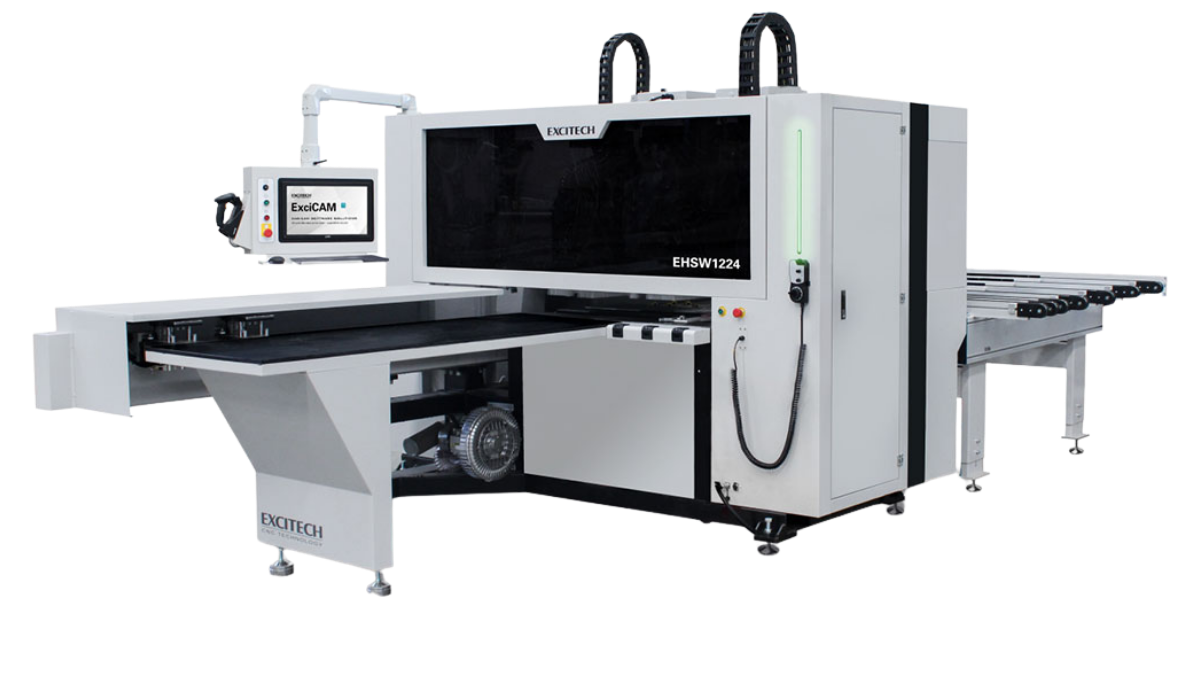
Chinese-built 6-sided through-feed drills like Excitech run around £35,000. European equivalents from Homag, SCM, or Biesse start at £80,000 — excellent machines, but 2–3× the price. The honest question: what does this machine need to earn for you, and by when? Machines should pay for themselves — not look impressive in the workshop.
Variant C — Existing Machines, No Software (from ~£8,000)
Often the cheapest and fastest solution. Many workshops have solid CNC machines running at 30–40% of their potential because there is no software connecting them. A joiner designs on paper. An operator manually enters dimensions into the nesting programme. Someone else writes macro programmes for the drill. It is like owning an aircraft and taxiing it around the runway. Implementing a single CAD/CAM platform that generates programmes for all machines can unlock capacity the owner did not know existed — with no new machines required.
Variant D — Fresh Start, Full Budget (from ~£150,000)
European nesting + 5- or 6-sided European CNC drill + full software suite. For businesses where maximum quality and UK manufacturer service are non-negotiable. Nesting from SCM, Felder, or Homag (£80,000–150,000), 6-sided drill (£50,000–180,000), complete software integration. Investment 2–3× higher than Variant B, but with the most comprehensive support network for production-critical operations.
What Not to Buy — Mistakes That Cost Real Money
| Mistake | Why It Fails | Better Approach |
|---|---|---|
| Nesting “that does everything” without a dedicated drill | Horizontal boring on a router is slow — table occupied, pumps running, small panels shift. ~30 panels/shift vs 50+ for cutting only. | Use nesting for cutting + vertical boring; separate CNC drill for horizontal work |
| 4–6 spindle vertical drill as standalone | Same budget buys a 6-sided through-feed machine that does far more, far faster | Excitech 6-sided through-feed (~£35,000) delivers far more throughput for similar spend |
| Oversized specialist machine “for the future” | Workshops waited 12 months for custom machines, made a few cabinets, then closed. More common than anyone admits. | Buy for your current proven order volume. Scale when the volume is real. |
| Direct China import without local support | Commissioning and calibration is a different challenge from software setup. UK warranty on a direct import is a very different thing. | Use UK-based distributors for Chinese machines (e.g. Excitech through UK dealer) |
| Deciding on jointing system after buying machines | Surface-insert connectors work on MDF/plywood but fail on chipboard; high-end bespoke clients will not accept visible connectors. | Choose connector system first (dowels / confirmat / surface-insert), then specify machines around it |
The Financial Case — Numbers That Actually Add Up
A CNC drilling machine at £35,000 is approximately the annual salary cost of one skilled joiner in London. Two machines at £35,000 each equal the cost of two joiners. But those two machines, run by a single operator, will outperform two joiners on production throughput — and pay back within 12 months.
This is not about making joiners redundant. The problem is that those joiners do not exist in the numbers the market needs. London’s skilled joinery shortage is real and structural. Having two CNC machines and one operator gives you stable, predictable production capacity regardless of whether you can find — and afford — another skilled joiner at £250–300 per day.
| Scenario | Annual Cost | Output | Notes |
|---|---|---|---|
| 2 skilled joiners, manual production | ~£75,000/yr | Moderate, variable quality | Labour cost recurs every year |
| Variant B: nesting + 6-sided drill | ~£70,000 total capex | Higher, consistent, 2-shift capable | Year 2+: operator only (~£30,000/yr) |
| Year 2 saving vs manual | ~£45,000/yr | — | Plus £3,000–5,000 energy saving vs router |
Your Machine Options — What Each One Actually Does
Multi-spindle drill (from £6,000): Entry-level — four spindles on a rotating element plus a grooving saw. Good as a starting point. The bottleneck appears quickly at higher volumes: constant tool changes and manual panel positioning eat a large part of the working day.
5-sided CNC drill (from £50,000): Serious automation begins here. Machine bores from five faces simultaneously — insert a panel, retrieve a finished component. Proven machines: SCM Morbidelli CX 100/CX 110 (CX 110 has four drills per axis, resolving the single Y-spindle limitation) and the Homag Drillteq V-200 — a machine I have personally implemented across multiple workshops. Compact, handles drawer components at the small end and full cabinet sides at the large end. One limitation: single boring spindle in the Y-axis means you choose 5mm or 8mm drill permanently, and component orientation in software needs monitoring, particularly for drawers of varying widths.
6-sided through-feed CNC drill (from £35,000): The optimal solution for most production volumes. Continuous through-feed operation without vacuum clamping — mechanical retention is quieter and draws 3–10 kW versus 20–42 kW for a router with pumps. If space is limited, elements can be loaded and unloaded from the same side — the through-feed design is more flexible than it sounds.
Nesting centre / CNC router (from £25,000): Universal machine — cutting, boring, routing, grooving. Essential for non-rectangular shapes. Limitation at production scale: one full panel with vertical drilling and routing takes 12–15 minutes, capping throughput at around 30 panels per shift. Pair with a dedicated drill for horizontal work, or accept the throughput ceiling if your order volume supports it.
Panel saw as nesting alternative (from £60,000): For workshops that cannot fit a nesting centre. Excellent precision for straight cuts — no machining allowance needed on the cut edge, unlike nesting (2mm per face required). Cannot cut curves or complex profiles. Saw + CNC drill is a proven, well-tested production combination.
Four Real Case Studies — What Actually Happened
Case Study 1
Drillteq in a Tight Workshop
Situation: Strong Altendorf saw, zero CNC, everything manual. Workshop too small for a nesting centre — a large machine physically could not fit through the door.
Implemented: Homag Drillteq V-200 + Corpus (Lignumsoft) + Optimik cutting optimiser with touchscreen monitor and label printer at the saw.
Result: Optimik optimised cutting with natural veneer orientation (show-face vs balance-face), every element labelled with QR code. Operator scans at the Drillteq — machine processes three faces, rotates, finishes the fourth plus all borings. One person per machine. Running smoothly from day one of implementation.
Full case study →Case Study 2
Two CNC Machines, Zero Software
Situation: Workshop with a large Infotec nesting centre (with receiving table and vertical boring head) plus a Homag BHX 5-sided drill. Both machines running at roughly 35% of their actual potential.
Problem: A joiner spent one to two hours designing a kitchen on paper. The nesting operator manually entered dimensions. Someone else wrote macro programmes for the drill. Like owning an aircraft and taxiing it around the runway.
Result: Corpus connected both machines. No new machines purchased. Infotec handles vertical boring and all routing/nesting. Homag BHX handles horizontal boring, second-face drilling, specialist routings. Production went from crawl to full capacity.
Full case study →Case Study 3
Chinese Nesting, Missing Boring Head
Situation: London workshop already in the purchase process when we connected. Chinese nesting centre on order — without the vertical boring aggregate (it was an option; they skipped it to reduce cost).
Problem: Without vertical boring, high-standard bespoke production — no visible connectors acceptable — meant joiners hand-drilling everything the machine should have handled. Classic bottleneck.
Implemented: Corpus on G-code (Chinese controller, no proprietary format — worked perfectly). Excitech 6-sided through-feed drill (~£35,000). QR workflow: one click generates nesting programme and prints labels. Operator scans at Excitech, component fully bored in seconds. Lesson: always take every boring option at order stage — retrofitting later is either impossible or costs multiples of the original price.
Full case study →Case Study 4
Direct China Import — In Progress
Situation: New workshop opening with a limited budget. Decision made to import machines directly from China, bypassing UK distributors.
My position: I am not an advocate for this route. Commissioning and calibration is a different challenge from software setup. You do not know what state the machine will arrive in. UK warranty on a direct import is a completely different arrangement from buying through a local distributor.
Status: Machines in transit. When they arrive, we implement software and connect the full production flow. We will report results honestly — including any problems. This is genuinely unknown territory, and we are not pretending otherwise.
Follow this case →Key Considerations Before You Sign Anything
Service matters more than machine price. A breakdown without service access means a stopped production line. SCM, Biesse, and Homag have direct UK service presence. Independent dealers like Scott+Sargeant and VWM also provide post-sale support. Always establish who will service the machine — and in what timescale — before committing.
Warranty is 12 months — industry standard. Use that first year to test the machine on every edge case. Problems found inside the warranty window cost nothing. After 12 months, every repair is your cost.
New versus used. Used 5-sided CNC drills rarely appear on the secondary market in good condition — CNC machines are easy to damage with a badly prepared panel. Used routers over ten years old sell at 5–15% of new price, but may need expensive controller retrofits. The calculation rarely favours buying used for your core production machine.
Branded machines retain value. As your business scales, branded equipment holds its secondary market value. A 5-sided CNC drill is also easier to move and re-commission than a full nesting centre if your floor plan changes.
London means laminate inside, spray outside. This is the minimum standard for bespoke. Internal laminates run from a few dozen to £300–400 per board — Egger, Xylo, Cleaf, and others. Externally: spray lacquer, veneer, leather, metals, bespoke hardware — no limits. The production process for simple versus premium finish is nearly identical. The difference is in turnover and what stays in the margin. Aim for the higher standard — same production effort, dramatically better margin.
Frequently Asked Questions
What is the minimum budget to set up a productive CNC furniture workshop in London?
Variant A (panel saw + 5-sided CNC drill + software) starts from around £50,000–70,000 for a functioning production setup. Variant B (nesting + 6-sided drill + software) runs £70,000–100,000 using Chinese-built machines through UK distributors. European equipment roughly doubles these numbers. Software adds £8,000–25,000 depending on modules.
Is a nesting centre better than a panel saw for a small workshop?
It depends on floor space and production mix. If the workshop can fit a nesting centre, nesting is more versatile — it cuts curves, complex profiles, and bores vertically in the same operation. If space is genuinely restricted, a panel saw + CNC drill is proven and more space-efficient. The saw decision should come after the CNC drill decision, not before.
How quickly does a CNC drilling machine pay for itself?
At £35,000 with consistent production volume, payback is typically under 12 months — roughly equal to one year’s salary cost for a skilled joiner. From year two, the machine reduces labour dependency by approximately £30,000–45,000 per year, plus £3,000–5,000 in energy savings compared to a router-based setup.
Can Chinese CNC machines be used professionally in a UK workshop?
Yes — through established UK distributors. The key is a local UK service contact for commissioning, calibration, and warranty support. Excitech, for example, operates through a UK distributor and is well-established in London workshops. Direct import from China without local support is a materially different risk profile and is not recommended without specific experience commissioning industrial machinery.
What software do I need alongside the machines?
Software needs to do three things: furniture design (parametric cabinet modelling), production documentation (cutting lists, hardware lists, component labels), and CNC post-processing (machine-specific programmes for each piece of equipment). Corpus (Lignumsoft) and Cabinet Vision both handle all three. The software investment typically pays back faster than any single machine — because it is the multiplier that makes all the machines work at their actual potential.
When does it make sense to bring in a CNC consultant before buying machines?
Always — before committing capital. A few hours of consultation before a purchase costs a fraction of one wrong machine decision. The consultant should understand your production type, floor layout, jointing system, and software plans before recommending anything. If machines are already in place, the focus shifts to optimising software and workflow around what exists, rather than retrofitting a machine specified for a different production profile.
Planning Your First CNC Workshop?
We work with London furniture workshops at every stage — from pre-purchase machine specification to full software implementation and operator training. See how we have done it for real businesses.
No commitment required. Initial conversation is free.